Back to A Swashbuckling Campaign: Index.
This section adapts game concepts (action stations, wind dynamics, and sailing with or close to the wind) from Limithron’s Guide to Naval Combat for 5e.
The ocean is divided into 15-mile (25km) “flat-top” hexes. In clear weather, lookouts at the center of a hex can see to the center of adjacent hexes.
Time is measured in watches, each an interval of 12 hours beginning at dawn and dusk.
Wind
At the beginning of the watch, the GM rolls to determine the direction and speed of the wind. This information is trivially apparent to anyone abovedecks. The wind blows consistently throughout the 12-hour watch.
At the beginning of each watch, roll:
- 1d6 during Spring or Autumn
- 1d6+1 during Summer
- 1d6-2 during Winter
| Result | ||
|---|---|---|
| 0- | Still Wind | |
| 1 | Light Wind to the Southwest | |
| 2 | Heavy Wind to the Southwest | |
| 3 | Light Wind to the Northwest | |
| 4 | Light Wind due South | |
| 5 | Heavy Wind due South | |
| 6+ | Storm’s a’brewin’! |
If a storm is rolled, first roll 1d6 to determine the wind direction. On a 1, a heavy wind blows to the North; on a 2-6, a heavy wind blows to the corresponding direction clockwise from North. Second, roll 1d12 to determine the hour of the watch in which the storm hits.
As the wind flows toward brewing storm systems, a sudden change of wind direction from the previous watch is one telltale sign of an impending storm. Other signs may be observed by a trained lookout with a proper Perception or Naturecraft check. Most storms can be spotted without a check 1 hour before they hit.
Storm Roll
At the beginning of the watch, if the previous watch featured a storm, roll:
- 1d4 during Spring or Autumn
- 1d4-1 during Winter
- 1d6 during Summer
| Result | |
|---|---|
| 0-2 | The storm subsides. Roll as normal for weather. |
| 3-4 | The storm continues. Subtract 1 from the next watch’s storm roll. |
| 5-6 | The storm develops into a hurricane, which will last for 1d4+1 additional watches before subsiding. |
Riding Out Storms
Strike the sails During a storm, common wisdom dictates ships must strike the sails, batten the hatches, and wait it out, letting the minimum amount of sail unfurl to keep the ship pointed in a safe direction. When a storm hits, the ship’s Rigger must succeed on a DC 12 Influence or Finesse check to accomplish this. Additional Riggers collectively grant advantage 1 to the roll.
On a success, the ship takes no damage. On a failure, the ship takes half their primary attack damage over the course of the watch. On either result, the ship moves 1 hex in the same direction of the stormwind for every two hours the storm lasts (minimum of 1 hex).
Hurricane Winds During a hurricane, the speed of a ship is doubled; it moves 1 hex per hour with the sails struck. Depending on how long a hurricane will last, the GM may adjust the direction of the winds as appropriate to simulate the storm’s vortex, or even allow the ship to pass through the hurricane’s eye.
During each watch subjected to hurricane-force winds on open ocean, the Rigger on a ship must succeed on a DC 17 Influence or Finesse roll. The ship suffers its own primary attack damage on a failure, or half damage on a success. Additional Riggers grant advantage 1 to this roll.
Ride the storm! A crew that chooses to risk keeping the sails up may use the stormwinds to their advantage, moving the ship’s speed rating in hexes for every hour they remain up (or twice their rating in a hurricane). After every hour, the crewman acting as the ship’s Rigger must succeed on a DC 17 Influence or Finesse roll. The ship takes its primary attack damage on a failure, or half on a success. This damage is doubled during a hurricane.
The Rigger’s DC increases by 1 for each consecutive hour the sails remain unfurled during a storm. (This increase does not apply to the roll made when the ship’s Rigger Strikes the Sails). A ship which takes half of its own maximum HP when Riding the Storm suffers catastrophic damage to its sails and cannot sail until repaired.
Stormy Repairs A ship’s Carpenter may use their out-of-combat Repair ability to mitigate any storm damage taken during their watch. When the ship is Riding the Storm, the Carpenter may instead use their in-combat Repair ability once per hour. (Note that in-combat Repair only grants the ship temporary HP). All Repair rolls during a storm suffer disadvantage 1, though additional carpenters collectively grant advantage 1 to Repair rolls as normal.
Seeking Shelter The GM may roll a secret DC 12 Perception or Naturecraft check for any Lookouts to sight land during a storm. They do so at disadvantage 1, though a nearby active lighthouse or the like nullifies this disadvantage.
If land is sighted during a storm (including a hurricane), the Pilot can roll a DC 17 Might or Finesse check to maneuver the ship close to shore over the course of the following hour and drop anchor. On a success, the ship does so safely without risking additional damage. On a failure, the ship takes damage as circumstances dictate, and may become beached.
The ship takes no further damage when anchored near shore during a storm or hurricane.
Ship Speed
Ships have a speed rating between 2 and 8, though far more often between 3 and 6. Depending on windspeed, wind direction, and ship direction, the following table gives the number of hexes a ship may travel during 1 watch (12 hours).
Sailing “With the Wind” means sailing within 1 hex face of the wind’s direction. Sailing “Close to the Wind” means sailing within 1 hex face against the wind. A ship cannot sail directly against the wind.
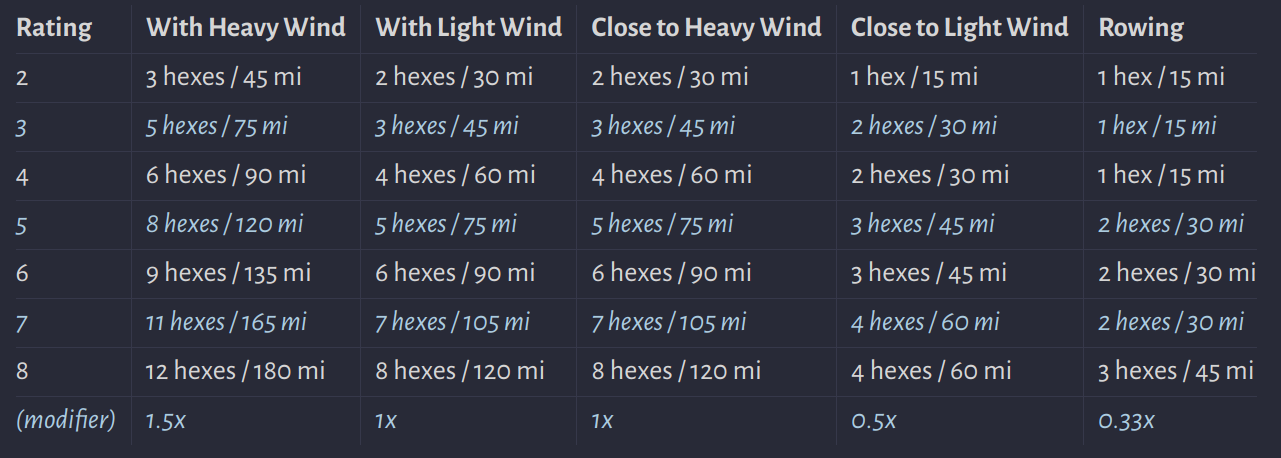
Fractional hex distances ending in .5 or greater are always rounded up; the minimum movement of any ship is 1 hex.
In doldrums, when winds fall still for long stretches, sailing becomes impossible. Most ships have either a wind mage and rowing capabilities to address such cases. A ship’s crew may spend a day—24 hours—rowing with no penalty. Commanding a crew to row more than 1 day in a row heavily reduces morale; the second consecutive day spent rowing inflicts the Stressed condition on the ship, which may be cleared after spending 1 watch resting.
Sailing and Magic
Characters who can cast Wind spells gain the following cantrip.
cantrip, 1 hour, cannot be cast during a storm
Gain 1 point to spend, and an extra point each once you are 5th, 10th, and 15th level (maximum of 4 points). Spend 1 point each to change the direction of the wind to an adjacent hex side. Spend 1 point each to change the wind speed by one step (from none, to light, to heavy; or the reverse).
This spell solely affects the ship the caster is on, and lasts until the end of the current watch. When the spell ends, you may perform a quick one minute ritual to sustain its effects for another watch. If you do, you may spend points once more to further change the strength and direction of the wind.
Every time the spell is sustained, the GM rolls 1d6 secretly. If the result is equal or lower than the number of times this spell has been sustained, a storm forms after 1 hour centered on the caster and lasting 1 watch, blowing in a random direction.
When any storm hits the ship, this spell immediately ends.
Watch Stations
While the ship is under sail, characters may work at the following stations. Manning a station for a Watch involves continuous work for at least 8 hours, which allows characters to engage in other activities for the remaining 4.
Captain
Each ship must have an assigned Captain. If none of the characters are currently the Captain of a ship they are on board, the GM assign an acting Captain.
At the beginning of each Watch, the Captain plots the course for the ship. They then roll a DC 12 Lore or Naturecraft check.
On a failure, the ship moves 1 hex slower than planned (minimum 1 hex movement), is pushed one random hex askew from their goal, and the GM adds a -1 modifier to any random encounter roll. On a success, the ship travels up to its full speed to the target hex. On a result of 17-21, the GM adds a +1 modifier to any random encounter roll; on a 22+, they add a +2 modifier to that roll.
Bosun
This station may be claimed at any time during the Watch.
Raise Morale. Make an Influence skill check. On a result of 12-16, you may grant +1d4 to 1 skill check of your choice made at a Watch Station during this watch; you may grant it to 2 skill checks on a 17-21, or 3 skill checks on a 22+.
On a result of 17+, you may instead temporarily remove the Stressed condition from the ship for the remainder of the Watch. This effect cannot be chosen on consecutive Watches.
Pilot
The Pilot moves the ship's token and makes reactive rolls using their own Might or Finesse as appropriate to any developing situation. For instance, they might need to evade pursuit, navigate dangerous reefs or shoals, or maneuver the ship to an advantageous position ahead of a looming combat.
The DC for any of these is determined by the GM based on the circumstance. Evading pursuit, for instance, would naturally be an opposed check.
Lookout
Unlike other stations, the Lookout role must be continuously maintained for all 12 hours of the Watch. Players may “trade off” on shorter shifts agreed between themselves and NPCs.
The Lookout rolls Perception or Naturecraft at the beginning of their shift. Depending on their result, they may determine if a Storm is heading towards the ship, spot nearby uncharted islands or other points of interest, or give advance warning of a random encounter.
The DC for any of these is determined by the GM based on the circumstance. Spotting an oncoming sea monster, for instance, would naturally be an opposed check.
Carpenter
The Carpenter rolls to Repair the ship using the their own Examination or Might skill. If there are multiple Carpenters, they grant Advantage on the roll equal to their number beyond the first.
Repair. On a result of 12-21, you grant the ship HP equal to half its primary attack damage. On a result of 22+, you grant HP equal to its primary attack damage instead.
Alternatively, if the ship has any temporary HP, you may convert half of it into HP on a roll of 12-21, or all of it on a roll of 22+.
Reminder: A ship’s temporary HP added to its current HP can never exceed its maximum HP. Temporary HP lasts no longer than 12 hours.
Rigger
The Rigger uses their Influence or Finesse skill to Reef the Sails, if the ship needs to suddenly slow or stop (or pull the sails down in advance of a coming storm). If there are multiple Riggers, they grant Advantage on the roll equal to their number beyond the first.
Reef the Sails. On a result of 12-16, the sails may be angled to catch less wind to slow the ship to half speed, taking about 5 minutes. They may also be stowed completely, taking about 10 minutes. On a 17+, slowing the ship takes 2 minutes, and stopping it takes 5.
On a result of 11 or less, an accident occurs.
Resting at Sea
In Nimble, three different rest actions are detailed. A “catch your breath” Field Rest allows characters to spend hit dice to restore HP. An 8-hour nightly Field Rest restores maximum values from spent hit dice. A Safe Rest restores all HP, hit dice, and mana; it also heals 1 wound.
The sea is rarely safe. While the ship is actively traveling, only Field Rests are possible. If the ship is anchored in a rare safe place—for instance, a hidden cove—the GM may determine that a Safe Rest is possible. Bringing the ship into a friendly port also allows for a Safe Rest.
Inventory
Each ship has a number of inventory slots that may hold cargo. These slots may hold nearly any sort of cargo, including additional food and water, gunpowder, carpentry supplies for repairs, as well as—of course—gold, trade goods, and loot.
Each inventory slot may hold up to 10,000 pieces of currency; however, a ship with more than half of its inventory slots filled with pure gold, silver, or platinum will take a -2 penalty to its speed rating.
A ship’s stat block lists how many days worth of supplies they can hold in their dedicated stores of food and water. This is separate from cargo inventory slots. Each slot in the hold may carry an additional 12 days of food and water beyond this store.
Each ship also carries supplies for reparing and maintaining the ship, expressed in the number of Watch-scale Repair actions the ship’s carpenter may take. Each inventory slot may hold a number of supplies for 6 additional Repair actions.
The campaign includes hundreds of uninhabited (or long abandoned) islands; when anchoring off the coast of one of these islands, the GM may allow Naturecraft checks for PCs to resupply the ship’s stores of food, water, and repair materials. Generally on a success (DC12), an individual crewman may gather 2 days worth of food and water over the course of a Watch, or 1 action’s worth of carpentry supplies; double this on a roll of 22+.
A player may alternatively roll Influence to directly manage a group of up to 5 crewmen gathering these supplies, multiplying the number of supplies an individual would gather in a Watch by the amount of people in the group. Count success on a 12+, and a critical success on a 22+ (doubling the amount of supplies gathered).
A particular deserted island may become exhausted of its potential supplies at the GM’s discretion; or, it may not have particular supplies at all.
When buying supplies in port, a player (typically the Captain) rolls Influence to haggle. Generally 1 day’s worth of food and water for the crew costs 10 gold, and 1 repair action’s worth of carpentry supplies costs 5 gold. Merchant disposition, existing relationships, the prosperity of the port, high Influence results, and so on, will combine to change these base prices on a case by case basis.
Larger sailing ships also typically include a Brig, where a set number of captured prisoners may be held securely. Crews of these ships include a rotation for keeping watch over prisoners the Brig. Over short spans of travel time, a ship may attempt to keep up to ten prisoners per inventory slot in the cargo hold, assuming the prisoners are tied up and a crew rotation keeps watch on them at all times. This is always a risky proposition; a cargo hold leaves plenty of places to hide. A dedicated Brig is always more fit for this purpose.
Sailing